Why the AI-Ready Stadium Is Now a Business Imperative
The same architectural shift that powered modern AI is now reshaping how stadiums must be built, operated, and monetized. Venues that unify their data, networks, and compute infrastructure will be positioned to reduce costs, improve operations, and unlock new revenue streams in real time.

In 2017, a research paper with a modest title helped trigger one of the most important technology shifts in modern business. The transformer architecture changed how artificial intelligence understands context, enabling systems to process information at scale and uncover relationships that older models could not see. That breakthrough did not just improve AI. It created the commercial foundation for today’s AI economy.
The lesson for stadium operators is not academic. It is architectural.
The real AI breakthrough was infrastructure
Before transformers, AI systems struggled to connect the dots. They processed information in sequence, losing context as data accumulated. Transformers solved that problem by allowing models to evaluate relationships across an entire dataset at once. That made language, prediction, reasoning, and pattern recognition dramatically more powerful.
But the transformer did not succeed because of software alone. It required massive compute capacity, specialized chips, data centers built for power-hungry workloads, and increasingly distributed processing close to where data is generated. In other words, AI became viable when the physical infrastructure caught up.
That same principle now applies to sports venues.
Stadiums are already data-rich. They are not yet data-connected.
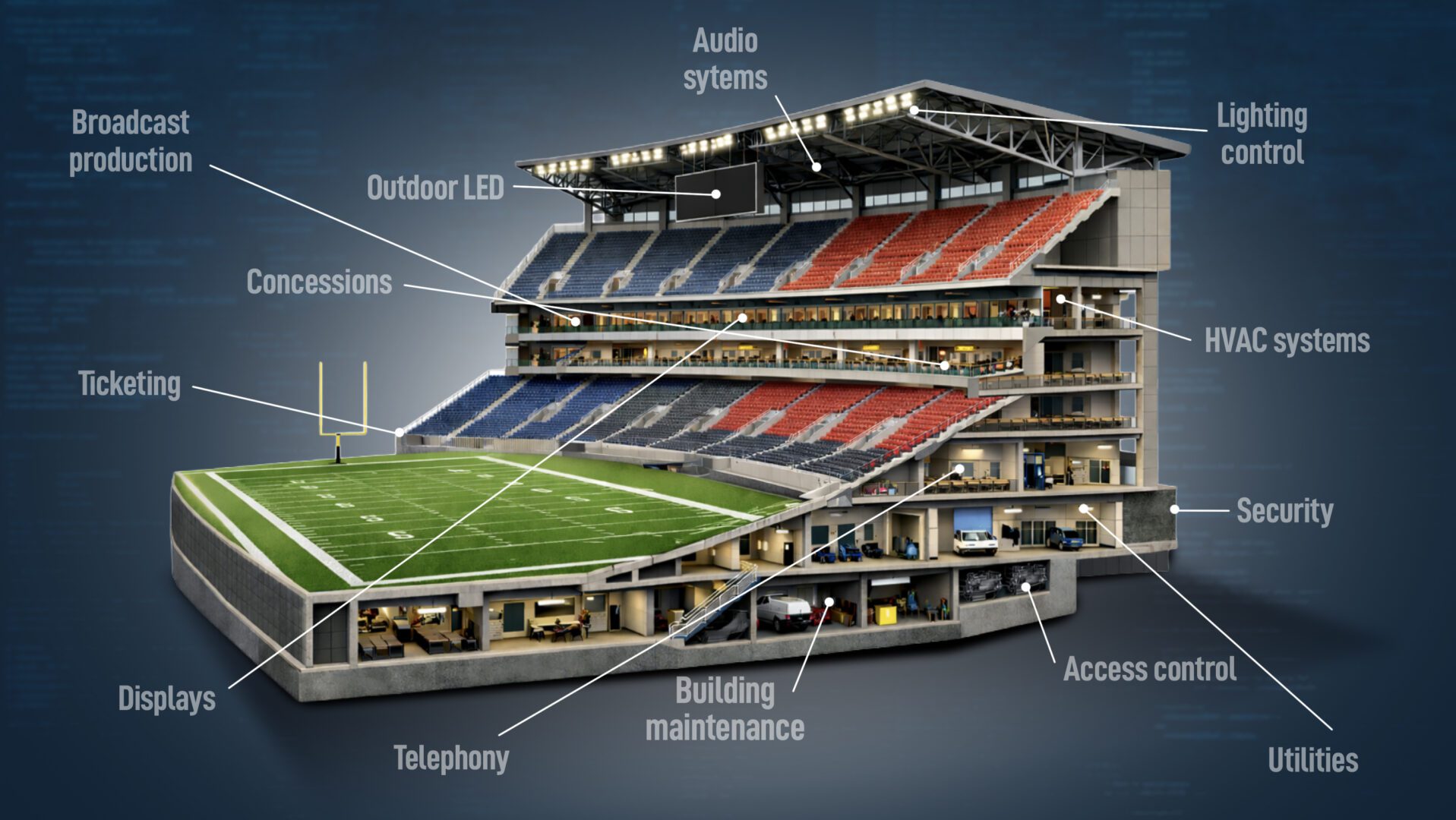
Major stadiums and arenas generate enormous amounts of operational data every event day. Ticket scans, Wi-Fi connections, concession purchases, security feeds, environmental controls, digital signage, and mobility patterns all produce signals about how the building is performing. Yet in most venues, those signals remain trapped in separate systems.
Security data sits in one platform. Concession data sits in another. Building automation, broadcast workflows, and fan engagement tools often operate independently. The result is a venue that collects more information than ever but understands very little of it in context.
That is the stadium equivalent of pre-transformer AI: lots of inputs, weak relationships, and limited intelligence.
Convergence is the new competitive advantage
The answer is a converged network: a shared infrastructure that carries multiple venue systems across one common platform. Convergence is not just an IT upgrade. It is the foundation that allows a stadium to analyze data across functions, rather than in silos.
Once systems can see each other, operators can begin answering high-value business questions. How does arrival timing affect concession demand? Which gates create the biggest staffing bottlenecks? When does Wi-Fi congestion signal an upcoming service issue? Which fan segments are most likely to respond to a targeted offer in the moment?
Without convergence, those questions remain guesses. With it, they become operational intelligence.
Why the stadium must become part of the AI stack
The next phase of AI is not only cloud-based. It is distributed. For many venue applications, the delay involved in sending data to a distant data center and waiting for a response is too slow. Crowd monitoring, security analytics, building controls, and live fan engagement all require decisions in seconds, not minutes.
That is why more venues are moving toward hyperconverged infrastructure, which combines networking, storage, and computing in integrated clusters at the venue level. This brings processing power closer to the action, allowing the building to respond in real time.
The business impact is immediate. Inventory can be adjusted before lines form. Staffing can shift before congestion spreads. HVAC and lighting can respond to actual demand. Offers can be delivered when they are most likely to convert. The stadium becomes not just a place where data is collected, but a node in the AI infrastructure itself.
The economics are bigger than efficiency
The most obvious case for AI in venues is operational efficiency, but the more disruptive opportunity is revenue expansion. When integrated data flows across ticketing, Wi-Fi, mobile engagement, concessions, and movement patterns, AI can help operators understand not just how many people are in the building, but how different audiences behave, spend, and respond.
That changes the economics of sponsorship, merchandising, food and beverage, premium experiences, and event-day labor. A generic impression becomes a targeted commercial moment. A fixed sponsorship asset becomes a dynamic one. A reactive operations model becomes predictive.
For venue owners, that means AI is not just a cost-control story. It is a monetization story.
Why this matters now
Technology leaders across the economy are pouring hundreds of billions of dollars into AI infrastructure because they understand that software alone does not create durable advantage. The physical layer matters. Stadium operators should be making the same calculation.
Most existing venues were built with isolated systems, and many are now in the middle of gradual technology refresh cycles. That makes the transition to convergence a strategic planning issue, not a one-time capital decision. New venues can build for AI from day one. Older venues can move in stages, using each upgrade to reduce fragmentation and improve interoperability.
The organizations that move first will gain more than operational efficiency. They will gain a building that learns, adapts, and monetizes more effectively over time.
The bottom line
The next major competitive divide in stadium business will not be between venues that use AI and venues that do not. It will be between venues built to make AI work and venues retrofitted too slowly to keep up.
The disruptive insight is simple: the smartest AI strategy may begin with the smartest stadium architecture.
Why It Matters
The same architectural shift that powered modern AI is now reshaping how stadiums must be built, operated, and monetized. Venues that unify their data, networks, and compute infrastructure will be positioned to reduce costs, improve operations, and unlock new revenue streams in real time.
Content Package
AI won’t win in stadiums with siloed systems. The competitive edge is AI-ready architecture: converged data infrastructure + edge compute for real-time decisions that unlock efficiency and new revenue.
#AIinSports#SmartStadium#SportsTech
Stadiums are already data-rich—but most are not yet data-connected. As transformer-era AI proved, the breakthrough wasn’t “just software.” Durable advantage required infrastructure: compute, specialized hardware, data centers, and distributed processing closer to where data is generated. That same lesson is now a business imperative for venue operators. ### From “inputs” to “context” On event day, stadiums generate massive signals: ticket scans, Wi‑Fi connections, concessions, security feeds, building controls, digital signage, and mobility patterns. The problem is fragmentation—security, retail, and building systems typically live in separate platforms. That creates the stadium version of pre-transformer AI: lots of inputs, weak relationships, limited intelligence. ### Convergence is the new competitive advantage The path forward is a converged network—shared infrastructure that carries multiple venue systems across a common platform. When systems can “see” each other, operators can move from guesses to operational intelligence: - How arrival timing impacts concession demand - Which gates create staffing bottlenecks - When Wi‑Fi congestion predicts a service issue - Which fan segments respond to offers in the moment ### The next phase is distributed AI (edge + hyperconvergence) Many high-value stadium use cases require decisions in seconds, not minutes: crowd monitoring, security analytics, building controls, and live fan engagement. That’s why hyperconverged infrastructure—integrated networking, storage, and computing at the venue level—is becoming essential. ### Bigger than efficiency: monetization AI isn’t only about cost control. Integrated data flows across ticketing, Wi‑Fi, mobile engagement, concessions, and movement patterns enable revenue expansion: - Dynamic sponsorship value (not just static impressions) - Smarter merchandising and premium experience targeting - More predictive event-day labor models ### Why it matters now The economy is investing heavily in AI infrastructure because the physical layer creates durable advantage. Stadiums are mid-refresh, and most were built with isolated systems—making AI readiness a strategic planning issue, not a one-time capital decision. **Bottom line:** The next competitive divide won’t be between venues that use AI and those that don’t. It will be between venues built to make AI work—and venues retrofitted too slowly to keep up. The smartest AI strategy may begin with the smartest stadium architecture.
#AIinSports#SmartStadium#SportsTech
Stadiums are data-rich—now they must be AI-ready. 🔗 Converge systems, run AI at the edge, and turn event-day signals into real-time decisions + new revenue. 🏟️✨ #StadiumTech #AIinSports #SmartStadium #EdgeAI #DataIntegration #VenueOperations #SportsBusiness #Hyperconvergence
#AIinSports#SmartStadium#SportsTech
Stadiums already collect tons of event-day data—but most can’t connect it across systems. The business opportunity is AI-ready architecture: converged infrastructure + edge processing for real-time decisions that improve operations and unlock revenue growth.
#AIinSports#SmartStadium#SportsTech
Picture this: your stadium has tons of data… but it’s trapped in silos. Ticket scans here. Security feeds there. Concessions somewhere else. So you can’t connect the dots. AI can’t deliver big value without the right foundation—just like transformer breakthroughs needed infrastructure, not just smarter code. Here’s the fix: converged stadium architecture. One shared platform for multiple systems, plus edge computing so AI can react in seconds—not minutes. Result? Fewer lines before they form, staffing that shifts early, HVAC and lighting that respond to real demand, and offers delivered when fans are most likely to buy. Bottom line: the competitive gap isn’t “AI vs no AI.” It’s AI-ready stadiums vs venues retrofitted too slowly.
#AIinSports#SmartStadium#SportsTech
Why is an AI-ready stadium a business imperative? Because data without connection is just noise. Most venues collect tons of signals—ticket scans, Wi‑Fi, concessions, security, building controls—but those systems don’t talk to each other. That means operators can’t use AI to make context-aware decisions. The lesson from AI’s transformer era is clear: durable advantage comes from infrastructure. For stadiums, that means converged networks that unify venue systems on one platform—plus edge compute so AI can respond in seconds. When you connect the data, you can predict arrival timing effects on concessions, prevent service congestion, optimize staffing before bottlenecks, and deliver targeted offers in the moment. Efficiency is the first win. Monetization is the bigger one. AI-ready architecture isn’t a nice-to-have—it’s how venues stay competitive.
#AIinSports#SmartStadium#SportsTech