AI Will Reshape Stadium Economics — But Only If Venues Fix Their Data First
AI is becoming a boardroom priority across sports and live events, but the real competitive edge is not the algorithm. Stadiums that can unify trusted, real-time data across operations will be better positioned to cut costs, improve fan flow, and unlock new revenue. Without that foundation, AI simply adds more noise to already fragmented venue systems.

AI has moved from a futuristic talking point to a board-level business issue across sports, stadiums, and live events. The question for operators is no longer whether AI will matter, but how quickly it can improve margins, streamline operations, and create new commercial upside.
That shift reflects a deeper change in venue economics. Stadium operators are being asked to do more with less: improve the fan experience, reduce labor inefficiencies, maximize premium inventory, and drive more spend through concessions and event-day activations. AI can help deliver those outcomes, but only if the venue can supply the right data.
The market’s biggest mistake is treating AI readiness as a software decision. In practice, the real constraint is data infrastructure. If a stadium cannot expose trusted, real-time signals from across its systems, AI will not create clarity — it will accelerate confusion.
For venue operators, the business case for AI falls into two categories: operational efficiency and commercial performance. That means cutting time, labor, and friction while increasing conversion, spend per attendee, and premium utilization. Both depend on a connected operational view of the building.
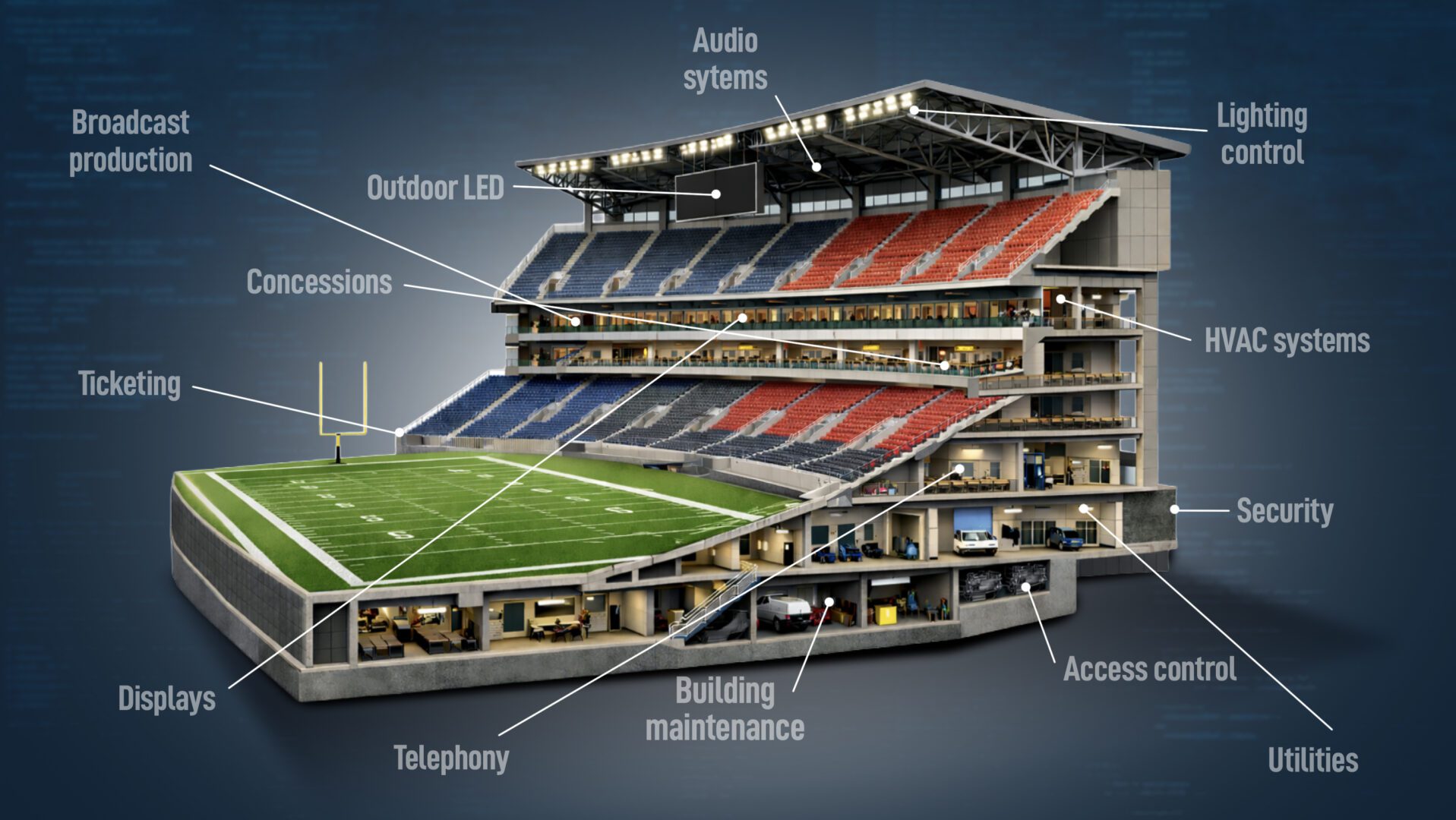
Most stadiums were not designed as unified digital businesses. They evolved department by department, with ticketing, security, concessions, marketing, and team operations often living on separate platforms. Each system may have solved a local problem, but the result is a fragmented environment that makes it difficult to trust the full picture.
That fragmentation carries a direct financial cost. Even basic questions can require multiple systems, manual reconciliation, and human interpretation. When answers arrive slowly or inconsistently, leaders hesitate — and AI becomes just another layer of technology instead of a decision-making tool.
For operators assessing readiness, two questions matter most:
- How quickly can the venue get an answer from its systems?
- Do decision-makers trust that answer enough to act on it?
If the answer to either question is no, the venue is not yet positioned to capture the full value of AI. The technology may still generate insights, but the operational impact will remain limited.
That is why the strongest AI strategies in stadiums begin with visibility. The most disruptive use cases connect the physical venue with digital intelligence in real time, allowing operators to respond while the event is still unfolding rather than reviewing performance after the fact.
Real-time signals from computer vision, LiDAR, ticketing, and point-of-sale systems can show how fans move, where congestion builds, and where demand is shifting. A unified data platform then standardizes those operational facts so every department works from the same source of truth.
This creates a practical AI operating model: see the live environment through venue signals, remember those signals in a unified data layer, decide with guardrails and human oversight, and prove impact through measurable goals, questions, and metrics.
One example shows the commercial and operational value of that approach. At a major tennis event, crowd-flow analytics revealed that large LED screens designed to enhance the fan experience were also creating congestion in specific areas. By correlating movement data with content playback, operators adjusted programming, improved circulation, and strengthened safety — while giving multiple departments access to the same information.
That is where AI becomes disruptive. It changes how venues manage space, labor, and content in real time. Instead of reacting after problems affect the guest experience, operators can intervene before those issues fully materialize.
Adoption barriers still remain, and trust is the biggest one. Stadium operations have long depended on experience and instinct, and AI outputs that do not match what staff see on the ground can quickly lose credibility. Building confidence requires not only accurate data, but also people who can translate insights into operational action.
Infrastructure is another constraint shaping the pace of adoption. Fiber and power remain the foundation of any future-ready venue. If a stadium lacks sufficient capacity in either area, adding sensors, processing, and real-time analytics becomes expensive and difficult.
That is pushing more venues toward edge computing, which allows data to be processed closer to where it is generated. This reduces network strain, supports faster decision-making, and still allows data to flow into cloud environments for broader analysis. As video and sensor volumes grow, that architectural balance becomes increasingly important.
Stadiums also operate under conditions far different from traditional enterprise environments. Events begin on schedule whether the technology stack is ready or not, and systems must perform under peak load with little tolerance for downtime. That reality demands AI deployments built for reliability, not experimentation.
Third-party systems will continue to play a role, but venues cannot afford to let vendor dependence block access to their own data. Automating data pipelines, improving governance, and reducing manual preparation will be essential if AI is going to create value at scale.
The competitive advantage will not come from algorithms alone. It will come from venues that can capture the right data at the right time, trust it, and act on it with confidence. In the next phase of stadium technology, the winners will be the operators that organize infrastructure for event-day decisions, not just post-event reporting.
For sports business leaders, the message is clear: AI readiness is no longer a theoretical conversation. It is a test of whether a venue can turn raw operational signals into faster decisions, better fan experiences, and stronger revenue performance.
Why It Matters
AI is becoming a boardroom priority across sports and live events, but the real competitive edge is not the algorithm. Stadiums that can unify trusted, real-time data across operations will be better positioned to cut costs, improve fan flow, and unlock new revenue. Without that foundation, AI simply adds more noise to already fragmented venue systems.
Content Package
AI “readiness” isn’t about picking algorithms—it’s about trusted, real-time data. Can your venue answer fast enough—and do leaders trust it to act during the event? That’s the real competitive test.
#SmartStadium#AIinSports#VenueManagement#SportsTech#DataDriven
AI has moved from pilot projects to board-level priorities across sports and live entertainment. The urgency is clear: leaders want faster decisions, lower operational friction, and measurable revenue lift. But there’s a misconception taking hold—AI readiness is not primarily a software-selection problem. The real bottleneck is data readiness: can your stadium expose trusted, real-time signals across ticketing, security, concessions, POS, and on-site operations? Why this matters for stadium economics Venue operators are under pressure to do more with less while improving the fan experience and maximizing premium inventory. The business case for AI typically falls into two buckets: • Operational efficiency (reduce time, labor, and friction) • Commercial performance (increase conversion, spend per head, and premium utilization) Both depend on a connected operational picture. Yet most stadiums weren’t built as unified digital businesses—they evolved department by department, often with fragmented platforms and silos. That fragmentation has a direct financial cost: even simple questions can require multiple systems, manual reconciliation, and human interpretation. When answers are slow or inconsistent, decision-makers hesitate—so AI becomes another layer rather than a decision engine. Two readiness questions that predict impact Before investing in models, ask: 1) How quickly can the venue get an answer from its systems? 2) Do decision-makers trust that answer enough to act on it? If either answer is “no,” AI may generate insights—but it won’t reliably change outcomes during event day. The most effective AI strategy starts with visibility The competitive advantage comes from connecting the physical venue to digital intelligence in real time. That means unifying operational facts so every department works from the same source of truth—enabling a practical AI operating model: • See: capture live signals from venue systems (computer vision, LiDAR, ticketing, POS) • Remember: standardize those signals in a unified data layer • Decide: apply guardrails with human oversight • Prove: measure impact with clear goals, questions, and metrics A real-world example: crowd-flow meets content In a major tennis event, crowd-flow analytics revealed that large LED screens intended to enhance the fan experience were creating congestion in specific areas. By correlating movement data with content playback, operators adjusted programming to improve circulation and support safety—while enabling multiple departments to act on the same information. Adoption barriers: trust, infrastructure, and reliability AI deployments fail when outputs don’t match what staff observe on the ground. Trust is built through accurate data and the right people to translate outputs into operational decisions. Infrastructure is the other constraint. Fiber and power capacity determine how feasible it is to add sensors, processing, and real-time analytics. That’s why more venues are moving toward edge computing—processing closer to where data is generated to reduce network pressure while still feeding cloud for broader analysis. Finally, stadiums operate under peak-load conditions with minimal tolerance for downtime. AI can’t be treated like experimentation; it must be engineered for reliability. The takeaway The competitive test isn’t algorithms—it’s whether your venue can capture the right data at the right time, trust it, and act with confidence during the event. In the next phase of stadium technology, the winners will be operators who organize for event-day decisions, not just post-event reporting. #StadiumTech #SportsAnalytics #AIinSports #VenueManagement #SmartStadium
#SmartStadium#AIinSports#VenueManagement#SportsTech#DataDriven
AI in stadiums starts with REAL-TIME DATA, not hype. Can you see the crowd, trust the signals, and act during the event? That’s the competitive edge. #SmartStadium #SportsTech #AI #DataDriven #FanExperience #EdgeComputing #VenueOps
#SmartStadium#AIinSports#VenueManagement#SportsTech#DataDriven
AI is becoming a board-level priority for stadium operators—but the real competitive advantage won’t come from “better algorithms.” The question is whether your venue can capture trusted, real-time signals across systems and get answers decision-makers trust fast enough to act during the event. Without reliable data, AI accelerates confusion—not clarity.
#SmartStadium#AIinSports#VenueManagement#SportsTech#DataDriven
In 30 seconds, here’s the real AI test for stadiums. Most teams ask: “Which AI software should we buy?” Wrong question. The real question is: “Can our stadium get trusted answers from its systems—fast—and will people trust those answers enough to act during game day?” If your ticketing, POS, security, and concessions data live in silos, leaders end up reconciling manually—so AI becomes another layer. The winners build visibility: sensors + computer vision + LiDAR + POS signals into one unified data layer. Then AI helps teams see, remember, decide with guardrails, and prove impact with metrics. AI isn’t the breakthrough—event-day data readiness is. Would you rather optimize after the event… or during it?
#SmartStadium#AIinSports#VenueManagement#SportsTech#DataDriven
AI readiness for stadiums isn’t about algorithms—it’s about data you can trust, in real time. Here’s the competitive test: when something happens—congestion, demand shifts, staffing pressure—how quickly can your systems answer? And do decision-makers trust that answer enough to act while the event is still unfolding? Most stadiums weren’t built as one connected digital business. Ticketing, security, concessions, and marketing often run on separate platforms. That creates silos, delays, and manual reconciliation. So AI doesn’t drive outcomes—it just adds complexity. The winning approach is visibility: connect physical venue signals—like computer vision, LiDAR, ticketing, and POS—into a unified data layer. Then use AI with human oversight and measurable goals to improve both operations and revenue. AI can’t fix a data problem. It amplifies what your venue can already see. Are you ready to act during game day?
#SmartStadium#AIinSports#VenueManagement#SportsTech#DataDriven
AI won’t fix stadium economics by itself—data will. Operators must unify trusted, real-time signals across ticketing, POS, security, and sensors. Without that, AI just adds confusion.
#SportsTech#StadiumManagement#AI#DataInfrastructure#FanExperience
AI has moved from “future talk” to a board-level stadium priority. But the core question for operators isn’t whether AI can help—it’s whether the venue can actually *turn operational signals into faster decisions, better fan experiences, and stronger revenue*. The biggest market mistake? Treating “AI readiness” as a software procurement problem. In practice, the constraint is data infrastructure. Stadiums were rarely built as unified digital businesses. Ticketing, security, concessions, marketing, and team operations often run on separate platforms, each solving a local problem—creating a fragmented environment where even basic questions require manual reconciliation. That delay (and lack of trust) is why AI can become “another layer of tech” instead of a decision tool. For AI to reshape stadium economics, venues need two answers: 1) How quickly can the venue get an answer from its systems? 2) Do decision-makers trust that answer enough to act? The most disruptive strategies start with visibility: - **See** the live environment through venue signals (e.g., computer vision, LiDAR, ticketing, point-of-sale) - **Remember** those signals in a unified data layer - **Decide** with guardrails and human oversight - **Prove** impact with measurable goals, metrics, and continuous improvement This matters commercially and operationally. When crowd-flow analytics revealed that premium LED content was also driving congestion in specific areas at a major tennis event, operators correlated movement data with content playback, adjusted programming, improved circulation, strengthened safety—and enabled multiple departments to act from the same source of truth. AI’s value is real-time intervention: managing space, labor, and content *before* guest experience degrades. But adoption still hinges on trust and reliability—especially in event-day conditions where uptime matters and “experiment later” isn’t an option. Infrastructure also sets the pace. Fiber/power capacity, sensor volumes, and network strain push many venues toward edge computing to process data closer to where it’s generated—while still flowing insights to the cloud. Bottom line: the competitive advantage won’t come from algorithms alone. It will come from venues that can capture the right data at the right time, trust it, and act on it with confidence. AI readiness is no longer theoretical. It’s a test of whether stadium operators can convert raw operational signals into margins, efficiency, and revenue—during the event, not just after the final whistle. — Stadium Tech Report | AI & Venue Economics
#SportsTech#StadiumManagement#AI#DataInfrastructure#FanExperience
AI won’t unlock stadium profit—data will. Unify trusted, real-time signals (ticketing, POS, sensors) so teams can ACT during the event. See • Remember • Decide • Prove. #SportsTech #StadiumOps #AI #DataInfrastructure #FanExperience #VenueManagement #EdgeComputing
#SportsTech#StadiumManagement#AI#DataInfrastructure#FanExperience
AI is becoming a board-level issue for stadiums—but the real bottleneck isn’t the algorithms. It’s data infrastructure. When venues can’t pull trusted, real-time signals across ticketing, security, concessions, and sensors, AI can’t improve operations or revenue—it only adds complexity. The winners will build visibility, trust the data, and make event-day decisions faster.
#SportsTech#StadiumManagement#AI#DataInfrastructure#FanExperience
AI in stadiums sounds futuristic… but the real question is: do you have the data to act? In this video: 3 reasons stadium AI fails when data isn’t fixed. 1) Fragmented systems. Ticketing, POS, security, sensors—each tells a different story. 2) Slow answers. If leaders can’t get insights in real time, AI becomes post-event reporting. 3) No trust. If AI output doesn’t match what staff see on the ground, it won’t drive action. What works? Build a unified, real-time view. See what’s happening with signals like computer vision and POS. Remember it in one data layer. Decide with guardrails and human oversight. Prove with measurable results. When venues do this, AI can reduce congestion, improve safety, and boost premium utilization—during the event, not after.
#SportsTech#StadiumManagement#AI#DataInfrastructure#FanExperience
Stadium AI won’t reshape economics—unless venues fix their data first. Here’s why: 1) Most stadiums aren’t “one system.” Ticketing, security, concessions, and marketing live in separate platforms. 2) That fragmentation makes basic questions take too long—and leaders don’t trust the answers. 3) Without real-time signals, AI can’t intervene while the event is unfolding. What’s the winning approach? Build visibility with live venue signals (ticketing + POS + sensors). Unify them into a trusted data layer. Use AI with guardrails and human oversight. Then measure impact on margins, labor efficiency, and premium utilization. Bottom line: algorithms are the easy part. Real advantage comes from data you can trust—at event speed.
#SportsTech#StadiumManagement#AI#DataInfrastructure#FanExperience