
Oracle’s AI database strategy points to a new control layer for enterprise infrastructure
Oracle is making a bold bid to move agentic AI closer to the core of enterprise operations by embedding more intelligence directly into the database. The strategy challenges the fragmented stack of vector stores, graph systems and lakehouses that many companies now rely on, and could reshape where control, compliance and speed live in the AI era.
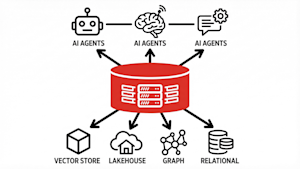
Enterprise data teams trying to move agentic AI from demo to deployment are running into a familiar bottleneck: the data layer. When agents depend on a mix of vector stores, relational databases, graph systems and lakehouses, the result is often a fragile web of sync pipelines that can’t keep context current under production pressure.
Oracle is making a direct architectural play to solve that problem where it believes it starts: inside the database itself. The company, which says its infrastructure supports the transaction systems of 97% of the Fortune Global 100, has unveiled a new set of agentic AI capabilities for Oracle AI Database that positions the database as the control point for enterprise AI.
The release centers on a unified engine that handles vector, JSON, graph, relational, spatial and columnar data without a separate synchronization layer. Oracle also introduced native vector indexing for Apache Iceberg tables, a standalone Autonomous AI Vector Database service and an MCP server that lets external agents connect without custom integration code.
The broader message is less about adding features and more about redefining where enterprise AI should live. Oracle is arguing that the old model of stitching together specialized systems is too brittle for production-scale agents, and that convergence inside the database is now a business necessity rather than a technical preference.
Oracle’s bet: the database becomes the AI operating layer
The core of Oracle’s announcement is the Unified Memory Core, a single ACID-transactional engine that processes multiple data types in one place. In practical terms, that means an agent can reason across structured and unstructured data without forcing teams to move information between systems just to maintain consistency.
That matters because every extra layer in an enterprise AI stack adds cost, latency and governance risk. By keeping memory and data in the same place, Oracle is pitching a model where policy enforcement, access control and transactional integrity are all handled at the database level instead of being bolted on afterward.
Oracle is also extending that logic to lakehouse environments with Vectors on Ice, which creates vector indexes directly on Apache Iceberg tables. That gives companies a way to query Iceberg-based data alongside Oracle-managed relational, JSON, spatial and graph data in a single workflow, reducing the need to shuttle information across platforms.
For developers, the company introduced a free-to-start Autonomous AI Vector Database built on Oracle 26ai, with a path to a full Autonomous AI Database as workloads grow. Oracle also launched an Autonomous AI Database MCP Server so external agents can connect without custom integration work, while inherited row-level and column-level permissions continue to apply automatically.
Why Oracle is targeting fragmentation fatigue
The strategic target here is not just AI adoption, but the operational pain that comes with fragmented infrastructure. Enterprise agent deployments often fail not because the model is weak, but because the surrounding data architecture cannot maintain freshness, consistency and governance at scale.
That makes Oracle’s pitch especially relevant for organizations already struggling with DevOps overhead across multiple systems. A separate vector store, graph database and relational layer may be manageable in a pilot. At production scale, it becomes a maintenance burden that can slow deployment and complicate compliance.
Oracle’s argument is that a converged database reduces that burden by collapsing multiple capabilities into one governed environment. Instead of forcing data teams to assemble an AI stack from scratch, the company wants the database itself to become the foundation for retrieval, reasoning and access control.
That is a disruptive move because it challenges the assumption that enterprise AI needs a best-of-breed stack stitched together by integration layers. If Oracle’s approach gains traction, the competitive battle shifts from standalone AI tools to the infrastructure layer that controls trust, speed and policy enforcement.
A crowded market, but a different strategic claim
Oracle is entering a market already populated by specialized vector database providers and cloud platforms that have added their own AI search and retrieval features. On the surface, many of the capabilities now being marketed as AI infrastructure have become table stakes across the enterprise database landscape.
The real distinction Oracle is trying to make is architectural. Rather than positioning vector search as an endpoint, it is presenting the database as a starting point that can expand into graph, spatial, time-series and other workloads without forcing a dead-end migration path.
That claim will resonate most with large enterprises that value consolidation, governance and transactional consistency over point solutions. It also reflects a larger shift in enterprise software: AI is no longer being sold as a layer on top of the business, but as a capability embedded into the systems that already run it.
For data leaders, the stakes are high. The decisions being made now about where agent memory lives, how access is enforced and which platform anchors the AI stack will shape cost structures and operating models for years.
Oracle’s message is clear: in the age of agentic AI, control of the database may become control of the business logic itself.
Why It Matters
Oracle is making a bold bid to move agentic AI closer to the core of enterprise operations by embedding more intelligence directly into the database. The strategy challenges the fragmented stack of vector stores, graph systems and lakehouses that many companies now rely on, and could reshape where control, compliance and speed live in the AI era.
Content Package
Oracle is pushing a new idea for enterprise AI: move agentic capabilities into the database itself. With a unified engine that handles vector, JSON, graph and relational data without a separate synchronization layer, Oracle aims to reduce the fragile, costly pipelines that slow real-world deployments. The announcement also includes native vector indexing for Apache Iceberg, an Autonomous AI Vector Database, and an MCP server for easier agent connectivity—positioning the database as the AI control point for governance, access, and consistency.
#Oracle#AgenticAI#DataInfrastructure#VectorSearch#ApacheIceberg#EnterpriseAI
Oracle is making a bold architectural bet for agentic AI deployments: fix the biggest bottleneck—the enterprise data layer—by turning the database into the AI control point. With a Unified Memory Core for multi-type data processing, native vector indexing for Apache Iceberg tables, and an MCP server for easier agent connectivity (without custom integration), Oracle is aiming to reduce the fragile “stitching” of vectors, relational systems, graphs, and lakehouses. The message for enterprise teams: fewer sync pipelines, better consistency, and centralized governance—so agents can move from pilots to production with less operational drag.
#AgenticAI#Oracle#AIInfrastructure#Database#VectorSearch#ApacheIceberg#Lakehouse#DataEngineering#MCP
Oracle wants the database to be the AI control plane. New agentic AI features unify vector, JSON, graph & relational processing—cutting brittle sync pipelines and shifting the power battle to enterprise data infrastructure.
#Oracle#AgenticAI#DataInfrastructure#VectorSearch#ApacheIceberg#EnterpriseAI
Oracle’s latest push for agentic AI capabilities inside Oracle AI Database is more than a feature drop—it’s a bid to redefine where enterprise AI “lives.” As teams move agentic AI from demos to deployment, they hit a familiar bottleneck: the data layer. Agents often require a patchwork of vector stores, relational databases, graph systems, and lakehouses. The result is a fragile web of synchronization pipelines—hard to keep context current, expensive to operate, and risky to govern under production pressure. Oracle’s strategy is to collapse that fragmentation by positioning the database as the control point for enterprise AI. The company introduces a unified engine (Oracle’s “Unified Memory Core”) designed to process multiple data types in one ACID-transactional environment—vector, JSON, graph, relational, spatial, and columnar—without relying on a separate sync layer. Key moves include: • Unified processing to reduce context drift across systems • Native vector indexing for Apache Iceberg via “Vectors on Ice,” enabling queries across Iceberg-based data alongside Oracle-managed data types • A standalone Autonomous AI Vector Database service to accelerate adoption • An MCP server so external agents can connect without custom integration code, while keeping inherited row/column permissions aligned The underlying message is architectural: for production-scale agents, convergence inside the database isn’t a technical preference—it’s an operational necessity. Oracle is arguing that the traditional approach (best-of-breed components stitched together) is too brittle when you add governance, access control, and transactional integrity requirements. In a crowded market where many vendors already market vector search and AI retrieval, Oracle’s differentiation is the claim that the database should be the starting point—not just the endpoint. If successful, the competitive battle shifts from standalone AI tooling to the infrastructure layer that controls trust, speed, and policy enforcement. For data leaders, the question isn’t only “Which AI model?” It’s: where will agent memory live, how will access be enforced, and which platform anchors the AI stack? Oracle is betting that whoever controls the database can shape the business logic for the next era of agentic AI. What do you think: will enterprises consolidate around unified database-driven AI—or keep building multi-system stacks for flexibility?
#Oracle#AgenticAI#DataInfrastructure#VectorSearch#ApacheIceberg#EnterpriseAI
Oracle just made a bold move: agentic AI inside the database. Unified engine for vector + JSON + graph + relational (no brittle sync pipelines). Database-as-control-plane = the new power shift. 🤖⚡️ #Oracle #AgenticAI #DataInfrastructure #VectorSearch #Lakehouse #ApacheIceberg #EnterpriseAI #AIDatabase #MCP #DataEngineering
#Oracle#AgenticAI#DataInfrastructure#VectorSearch#ApacheIceberg#EnterpriseAI
Oracle just dropped a big bet for agentic AI: make the database the control center. Here’s the problem—teams build agent demos using multiple data systems: vector stores, relational DBs, graphs, lakehouses. But in production, those sync pipelines break down. Context gets stale, governance gets messy, and costs rise. Oracle’s answer? Put the AI capabilities inside Oracle AI Database. They’re rolling out a unified engine that can handle vector, JSON, graph, relational, spatial, and more in one ACID transactional layer—reducing the need for separate synchronization. They also announced native vector indexing for Apache Iceberg tables, an Autonomous AI Vector Database, and an MCP server so external agents can connect without custom integration. Bottom line: Oracle isn’t just adding AI features—they’re trying to shift the power from stitched-together AI tools to the infrastructure that enforces trust, access, and consistency.
#Oracle#AgenticAI#DataInfrastructure#VectorSearch#ApacheIceberg#EnterpriseAI
Oracle’s new agentic AI move is a power shift. Instead of stitching vector stores, graphs, and databases together, Oracle wants the database to be the “AI control plane.” Why? Production agent deployments often fail at the data layer. Multiple systems mean brittle sync pipelines, stale context, higher latency, and governance headaches. Oracle’s pitch: unify vector, JSON, graph, relational, spatial, and columnar data processing inside Oracle AI Database using an ACID transactional engine—so agents can reason across data without constantly moving it between platforms. They also introduced native vector indexing for Apache Iceberg tables, plus an Autonomous AI Vector Database and an MCP server for easier agent connectivity. The big question: will enterprises consolidate around database-driven AI for governance and consistency—or keep building multi-system stacks for flexibility?
#Oracle#AgenticAI#DataInfrastructure#VectorSearch#ApacheIceberg#EnterpriseAI
Oracle says agentic AI’s biggest bottleneck is the data layer—and wants to fix it inside the database. Unified Memory Core + native vectors for Iceberg + MCP server: less stitching, more governance. #AI #Database
#AgenticAI#Oracle#AIInfrastructure#Database#VectorSearch#ApacheIceberg#Lakehouse#DataEngineering#MCP
Oracle’s latest AI database push is a direct response to a problem enterprise teams keep hitting when moving agentic AI from demo to deployment: fragmentation. In production, agents don’t rely on a single store—they need a mix of vector search, relational data, JSON, graph, and lakehouse assets. The result is often a fragile mesh of sync pipelines and brittle “context freshness” mechanisms that struggle under real operational pressure. Oracle’s strategy is to collapse that complexity by repositioning the database as the control layer for enterprise AI. The headline: a unified engine (the “Unified Memory Core”) designed to process multiple data types in one ACID-transactional place—so teams don’t have to move information across systems just to keep consistency. Key moves from the announcement: - Unified handling of vector, JSON, graph, relational, spatial, and columnar data—aiming to eliminate the need for a separate synchronization layer. - Native vector indexing for Apache Iceberg tables (“Vectors on Ice”), connecting lakehouse workflows to Oracle-managed capabilities. - A standalone Autonomous AI Vector Database service to start small, with a path to broader autonomous workloads. - An MCP server so external agents can connect without custom integration code, while row/column permissions continue to apply. What’s strategically notable isn’t just the feature list—it’s the argument behind it. Oracle is challenging the “best-of-breed stack” assumption for enterprise AI infrastructure. Instead, it claims convergence inside the database reduces cost, latency, and governance risk by centralizing policy enforcement, access control, and transactional integrity. In a crowded market where many vendors market vector search as table stakes, Oracle’s bet is architectural: the database shouldn’t be the endpoint—it should be the foundation that can expand into broader workloads (and avoid dead-end migrations). For data leaders, the question becomes less “which AI tool?” and more “where does AI memory live, who governs it, and which platform anchors trust and speed?” If Oracle’s approach lands, the competitive battle may shift toward the infrastructure layer that controls those fundamentals. #Oracle #AIInfrastructure #AgenticAI #DataEngineering #Database #Lakehouse #Governance
#AgenticAI#Oracle#AIInfrastructure#Database#VectorSearch#ApacheIceberg#Lakehouse#DataEngineering#MCP
Agentic AI is hitting one wall: the data layer. Oracle’s move? Put the “control layer” inside the database with Unified Memory Core, native vectors for Iceberg, and an MCP server. Less sync chaos. More governance. 🚀 #AgenticAI #Oracle #AIDatabase #VectorSearch #Iceberg #Lakehouse #DataEngineering #EnterpriseAI #MCP
#AgenticAI#Oracle#AIInfrastructure#Database#VectorSearch#ApacheIceberg#Lakehouse#DataEngineering#MCP
Oracle says agentic AI is failing in the real world for one main reason: the data layer. Right now, teams stitch together vector stores, relational DBs, graphs, and lakehouses—and the sync pipelines can’t keep context fresh under production pressure. Oracle’s answer: don’t patch the stack… collapse it. They’re positioning the Oracle AI Database as the control layer with a Unified Memory Core that handles multiple data types in one ACID transactional engine. They’re also adding native vector indexing for Apache Iceberg tables, plus a standalone Autonomous AI Vector Database and an MCP server so external agents can connect without heavy custom integration. Bottom line: Oracle wants the database to be where trust, access control, and “agent memory” live—so enterprise AI is governed, consistent, and easier to run at scale.
#AgenticAI#Oracle#AIInfrastructure#Database#VectorSearch#ApacheIceberg#Lakehouse#DataEngineering#MCP
Agentic AI has a production problem: the data layer. Teams often combine vector stores, relational databases, graphs, and lakehouses—then spend weeks building sync pipelines to keep agent context fresh. In production, those pipelines get brittle. Oracle’s big move: make the database the control layer. With its Unified Memory Core, Oracle claims a single ACID-transactional engine can process multiple data types together—so structured and unstructured data stay consistent without extra synchronization layers. They’re also bringing native vector indexing to Apache Iceberg tables (“Vectors on Ice”) for lakehouse workflows, and adding an MCP server so external agents can connect without custom integration code. If Oracle’s approach sticks, the AI stack may shift from “best-of-breed tools” to “one governed infrastructure layer” that handles access control, policy enforcement, and transactional integrity. What do you think: can the database truly become the AI operating layer?
#AgenticAI#Oracle#AIInfrastructure#Database#VectorSearch#ApacheIceberg#Lakehouse#DataEngineering#MCP


